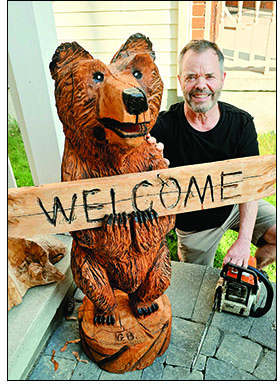
 Some artists use paint brushes and a pallet, while others may use pencils or even pastels. Still others create their art with a camera, or using pieces of stained glass. Orléans resident Gaetan Bernier creates his art with a chainsaw, or at least that’s how he starts.
Bernier is a wood carver. He began wood-working over 40 years ago, making pieces of furniture. Then, just over 20 years ago, he took a course on carving wood reliefs that was taught by accomplished woodcarver André Brault at the Orléans Visual Arts Centre.
During the COVID-19 pandemic, Bernier was binge watching YouTube videos when he came across a video on carving animals from a single section of tree trunk using a chainsaw.
“I saw the video and I thought, ‘I can do that’. I had skills with a chainsaw and there is always lots of free wood around, ” recalls Bernier, whose specialty is bears, but he’s also carved a couple of eagles.
Bernier describes the first few pieces he made as “very modest” in terms of both their scale and in detail.
He mostly works in pine and starts by first deciding what he wants to carve and how big it will be. He then goes out and starts foraging for fallen trees that are the proper size for each project.
Once he has the wood, he projects a picture, or drawing on to it and makes a rough chalk outline. After he draws the outline, he slowly begins to cut away the excess wood to create a rough form of whatever animal he is carving.
When he’s happy with the form, he starts doing the more detailed work with a Dremel rotary tool and hand chisels.
It can take upwards of 30-40 hours to complete each carving. Although Bernier is retired, he does a few renovation jobs on the side and carves whenever he has some free time.
Over the past four years he’s made 15 or 18 carvings, or there abouts, must of which he’s given away as presents to his daughter and brother-in-law. More recently, he’s made two carvings for some neighbours who were more than happy to pay for his time.
Bernier says the secret to being a good chainsaw carver is to be patient.
“You need to take your time and don’t cut too much wood,’ says Bernier. “Small mistakes are easier to fix than the big ones.”
And, of course, there is always lots of free wood around in case the mistake is too big to fix.











 CUMBERLAND FARMERS’ MARKET from 9 a.m. to 1 p.m. at the R.J. Kennedy Arena in Cumberland Village with a variety of local farmers and vendors ready to showcase their freshest produce, handmade goods, and unique finds! FREE ADMISSION
 SDBC TAPROOM SERIES presents Two Crows for Comfort with special guest Dan Kelly live and in concert from 7 p.m. Tickets $10 available at
  TRIVIA NIGHT from 7:30 p.m. every Monday night at the Royal Oak Pub Orléans. Free to play. Prizes for the winning team! The Royal Oak Pub is located at 1981 St. Joseph Blvd. near Jeanne d’Arc. For more info visit
  TRIVIA NIGHT from 6:30 p.m. at the Stray Dog Brewing Company. Exercise your grey matter before it turns to mush over the holidays. Reservations are a must to secure your spot. Send your team name and number of people to info@straydogbrewing.ca. The Stray Dog Brewing Company is located at 501 Lacolle Way in the Taylor Creek Business Park.
 ORLÉANS FARMERS’ MARKET from 11 a.m. to 4 p.m. in the parking lot of the Ray Friel Recreation Complex on Tenth Line Road. Browse 130+ local vendors, grab a bite, and discover amazing handmade and local finds. Plenty of parking available.