Plans to build 31 rental units next to the Queenswood United Church on Kennedy Lane East in Queenswood Heights is being met with opposition from some area residents.
The development project is part of the United Church of Canada’s efforts to create mixed-income housing units on its properties across the country. Their aim is to build homes for 34,000 people over the next 15 years through a subsidiary called Kindred Works, starting with the Queenswood United Church site.
The rental units will not only provide affordable housing for people, they will also provide the church with a much-needed revenue source and allow it to remain viable in the community.
Without the added income the project will provide, the church could be forced to close and the land sold to outside developers.
The Queenswood project will include a mix of three-storey townhouses and walk-up apartments, totaling 81 residential rental units of varying sizes from one to three bedrooms. Thirty-one per cent of the housing units would be “affordable,” as defined by the CMHC NHCF program, with rents set at 79 per cent of the average market rent, but first they must get the site rezoned from institutional to residential.
The site is privately owned and abuts Queenswood Ridge Park.
Opponents of the project are worried it will negatively impact the community by significantly increasing the amount of traffic and noise in the area. They also object to the loss of greenspace should the project be allowed to proceed.cThey’ve suggested that the City buy or expropriate the church and adjoining land and then lease the building back to the church for $1.
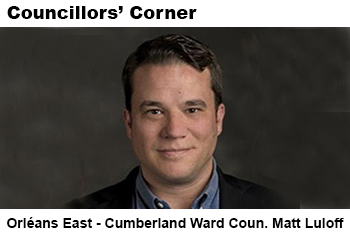
Orléans Ward councillor Matt Luloff says the idea of expropriating a church is a non-starter. There is also no interest on the part of the church to sell the land. For one thing, the project is part of a nation-wide initiative by the United Church of Canada. For another, even though the site is currently green space, it is privately owned, and private property laws are pretty clear.
The city could turn down the rezoning application, but it would almost certainly be appealed to the Ontario Local Planning Appeal Tribunal which almost always rules on the part of the property owner.
For his part, Luloff plans to raise the concerns to members of the planning committee which will decide on the rezoning application, some of which he shares. For instance, he wants the developer to ensure that any three-storey units are not immediately facing the neighbouring two- storey properties.
Luloff has asked planning staff to address as many of the concerns as possible in their report when the application is eventually brought to committee. If he’s not satisfied, he will pull delegated authority and force the site plan to go to committee for their scrutiny and public input.











 FIRST ANNUAL FINE ART SHOW presented by Arteast featuring 41 local artists in a variety of mediums from 10 a.m. to 4 p.m. at the Pineview Golf Club, 1471 Blair Rd. FREE ADMISSION.
 TRIVIA NIGHT from 7:30 p.m. every Tuesday night at the Royal Oak Pub Orléans. Free to play. Prizes for the winning team! The Royal Oak Pub is located at 1981 St. Joseph Blvd. near Jeanne d'Arc. For more info visit
  TRIVIA NIGHT from 6:30 p.m. at the Stray Dog Brewing Company. Exercise your grey matter before it turns to mush over the holidays. Reservations are a must to secure your spot. Send your team name and number of people to info@straydogbrewing.ca. The Stray Dog Brewing Company is located at 501 Lacolle Way in the Taylor Creek Business Park.
 CORO VIVO presents an evening of 60s and 70s music at Orleans United Church, 1111 Orleans Blvd at 7:30 p.m. Music that asks you to be in touch with your inner self and to just feel being groovy or feeling that disco beat. Tickets $30 available at